WEEK 07 · 2026-02-23 ~ 2026-03-01
Consultation
Integrated the PIC/FLIP simulation into the 3D city for the first time. Showed it at the group consultation and received three pieces of feedback pointing in the same direction. The word that came out of the session was simplify.
The dissertation was submitted at the end of Week 6. This was the first week since January where my entire attention could go back into the application. Two things happened. I finally connected the PIC/FLIP simulation into the 3D city model, something that had been sitting as two separate pieces of the project since Week 5. And the atelier scheduled its group consultation this week, which meant the integrated version had to be shown in front of faculty and classmates before I had really had time to sit with it myself.
INTEGRATING THE PIC/FLIP INTO THE CITY
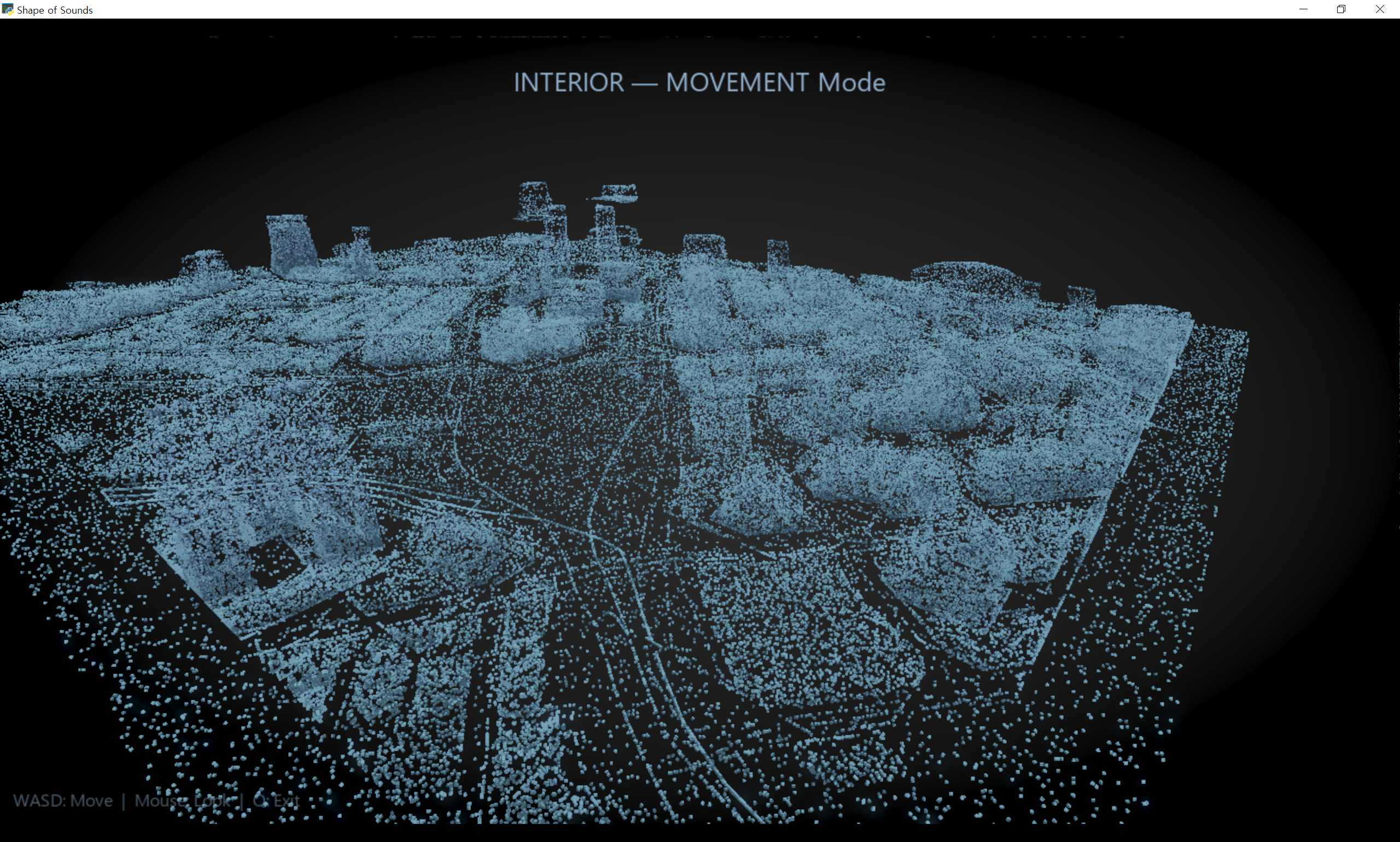
The two pieces had been running in parallel for the last two weeks. The Bugis city model existed as a static Blender export inside the application. The PIC/FLIP fluid simulation existed in its own scene, responding to audio but not to any surrounding geometry. Connecting them was not a huge engineering task on its own. It was a coordinate system alignment, a geometry pass that tells the fluid where the buildings are, and an audio input that drives force values across the particle field. Done in stages across two days.
Prototype
The first wired-up build. City model loaded, fluid solver running in the same scene, no coupling yet between them.
Errors
The first coupling pass produced visible artefacts. Particles leaked through geometry, pressure solved into unstable spikes.
What mattered more was what happened when the two came together. Particles moving through the volumes between buildings. Some settling on the ground planes, some drifting at roof height, some streaming through alleys as the audio changed. The first time it ran cleanly I recorded screenshots across different moments of the audio, from quiet stretches to the loudest peaks, to see what the system was producing.
After Insert Fluid
The breakthrough moment. Fluid and city coupled correctly, particles responding to both the audio field and the building geometry at the same time.
Particle Shadow Check
A sanity pass on shadow sampling. Confirming the particles were receiving occlusion from the city geometry and not sitting as a flat overlay on top of it.
Viewing Angles
Different camera framings of the integrated system to see which reading of the scene carried the most information.
Looking at the screenshots afterwards, something felt off. The work was technically impressive to me in the sense that I had built the thing and it was doing what I asked it to do. But I could not answer the question of what a viewer who did not know the project would take from it. The particles moved, the city sat underneath them, and there was no clear moment that said “this is the sound of Bugis” or “this is the point the project is making.” The integration had succeeded on the engineering side and raised a larger question on the design side.
THE GROUP CONSULTATION
The atelier’s group consultation was scheduled for later in the same week. Faculty and other students in the programme gather, each person presents where their project is, and the group responds. This was the first time my project was seen by an external audience. The dissertation reading is private. The application, up to this week, had only been seen by me and my supervisor.
I showed the integrated build. Some walkthrough footage, a live playthrough with audio, a brief explanation of the three pillars framework from the dissertation. What came back from the room was consistent enough that I stopped taking notes halfway through and just listened.
-
The supervisor · balance
Andreas said the same thing he had said in Week 5, in different words. The technical weight of the project is still too heavy, and the design side is not yet visible. The balance between design and technology has to be at the centre of the work, and right now it is not. This was the second time the same feedback arrived in similar language, which is not something I could ignore.
-
Other students · what are you trying to show
The students watching the demo said they could not tell what I was trying to show. The visuals were impressive to look at, but the purpose, the thing I had written about at length in the dissertation, was not readable from the work itself. Several people asked variations of the same question. What is this for. What should I be seeing. What do you want me to feel. None of these had clear answers in the current state of the build.
-
A classmate's advice · simplify
One specific piece of advice came out of the same conversation. “The project does not have to be this grand. Try simplifying it a little.” The person who said it meant it as a way out of the problem the first two pieces of feedback had named, not as a criticism. Strip things back. Let one idea sit in the foreground. Do not try to put the whole three pillars framework on screen at once. Do less, on purpose.
The three pieces of feedback were pointing at the same thing from different sides. The supervisor said the design was being crowded out by the technology. The students said they could not read the purpose from the work. The classmate’s advice was how to fix both. Make the work less. The technical ambition was not the problem. The amount of technical ambition visible at once was.
FINAL RESULT · END-OF-WEEK STATE