WEEK 09 · 2026-03-09 ~ 15
From station to taxi
The second group consultation said the design and the technology were finally in balance, then questioned the project's entry point itself. By week's end the MRT station was replaced by a first-person taxi interior, which the project still uses.
Last week ended with two things in place. The PIC/FLIP particle system had been built into a real working system. The MRT station exterior had been designed as the visitor’s entry point. Both were responses to the simplify feedback from Week 7. Going into this week’s group consultation, I thought the hard question had been answered. What came back from the room was that the hard question had not been asked yet.
By Sunday the MRT station was no longer the entry point of the project. A taxi interior was. The rebuild took the rest of the week and produced the version of the exterior I am still using now.
THE SECOND CONSULTATION
The atelier scheduled another group consultation this week, the same format as Week 7. Faculty and classmates gathered, each person showed where their project was, and the group responded. I came in more confident than last time because the work had changed shape. The integration was running, the MRT station was visually coherent, and the feedback pattern from Week 7 seemed to have been addressed.
Andreas’s first response agreed with that reading. The balance between design and technology, the thing he had flagged in Week 5 and Week 7, was no longer the problem it had been. The visuals were working. The technical complexity was still present but it was not drowning the design out any more. That sentence alone would have been enough to make the week.
Then he asked a different question. Imagine a tourist who is about to visit Singapore for the first time and lands on this project before the trip. What is the first thing they should see. Is the MRT station really the right answer.
The room agreed with the question immediately. The other students chimed in with variations on the same point. The MRT is how you move once you are already in Singapore. It is not what you picture when you think about going there. It is a means, not a destination. As an entry point for a piece about the sound of a city, starting someone at a subway station asks them to care about transit infrastructure before they have been given a reason to care about the city at all.
I agreed almost immediately. The truth is I had been uneasy about the station for a few days already. The visual language was working but the atmosphere felt slightly off from what I was trying to evoke. I had not put a finger on why. The consultation named it.
FROM STATION TO TAXI
The replacement came out of the same conversation. If the entry point should be the moment someone actually arrives in Singapore, the honest answer is a taxi. A visitor lands at the airport, walks to the taxi stand, gets in, and the city starts moving past the window. That is the real first experience of the place. The MRT comes later, once they are already there.
A taxi also gives the project something the station did not. The visitor is inside a closed interior looking out at a changing exterior. That is already the spatial grammar of the work. Interior holds the audio, exterior holds the particles and the architecture, the window is where the two meet. The MRT station had to simulate that relationship. The taxi is that relationship.
Week 8 version. The entry point was a hologram rendering of a Bugis MRT station. Visually coherent, conceptually the wrong first moment for a tourist-facing piece about the sound of Singapore.
Week 9 version. First-person view from inside the taxi at night. The hologram treatment is retained, now applied to the cab and the city seen through the window rather than to the station itself.
The hologram treatment from Week 8 carried over. The reason for using it in the first place, that the work is a reinterpretation rather than a simulation, is still true under the taxi framing. What changed was what the hologram is applied to. Week 8 used it on a piece of transit architecture. Week 9 uses it on the city seen through a moving window.
BUILDING THE TAXI EXTERIOR
The rebuild happened fast. Most of the architecture work had already been done for the station so the modelling skills and the shader setup were in place. What had to be made new was the scenario. Not a stationary platform this time but a first-person interior with the city sliding past outside.
The scene is a night scene. Late enough that the city lights are the dominant visual and the ambient dark gives the hologram textures room to breathe. The visitor is sat in the back of a taxi, having just landed, heading toward wherever they are staying. The buildings outside are not random. I modelled each one individually, sized and positioned and rotated so the skyline reads as a real route through the city rather than as a single repeating background. The feeling I wanted is the one you get the first night of a trip, when the city outside the window is still anonymous but already full of sound.
Interior · inside the cab
The cab as the frame the visitor sits inside. Everything the work does is seen through this space.
Exterior · city past the window
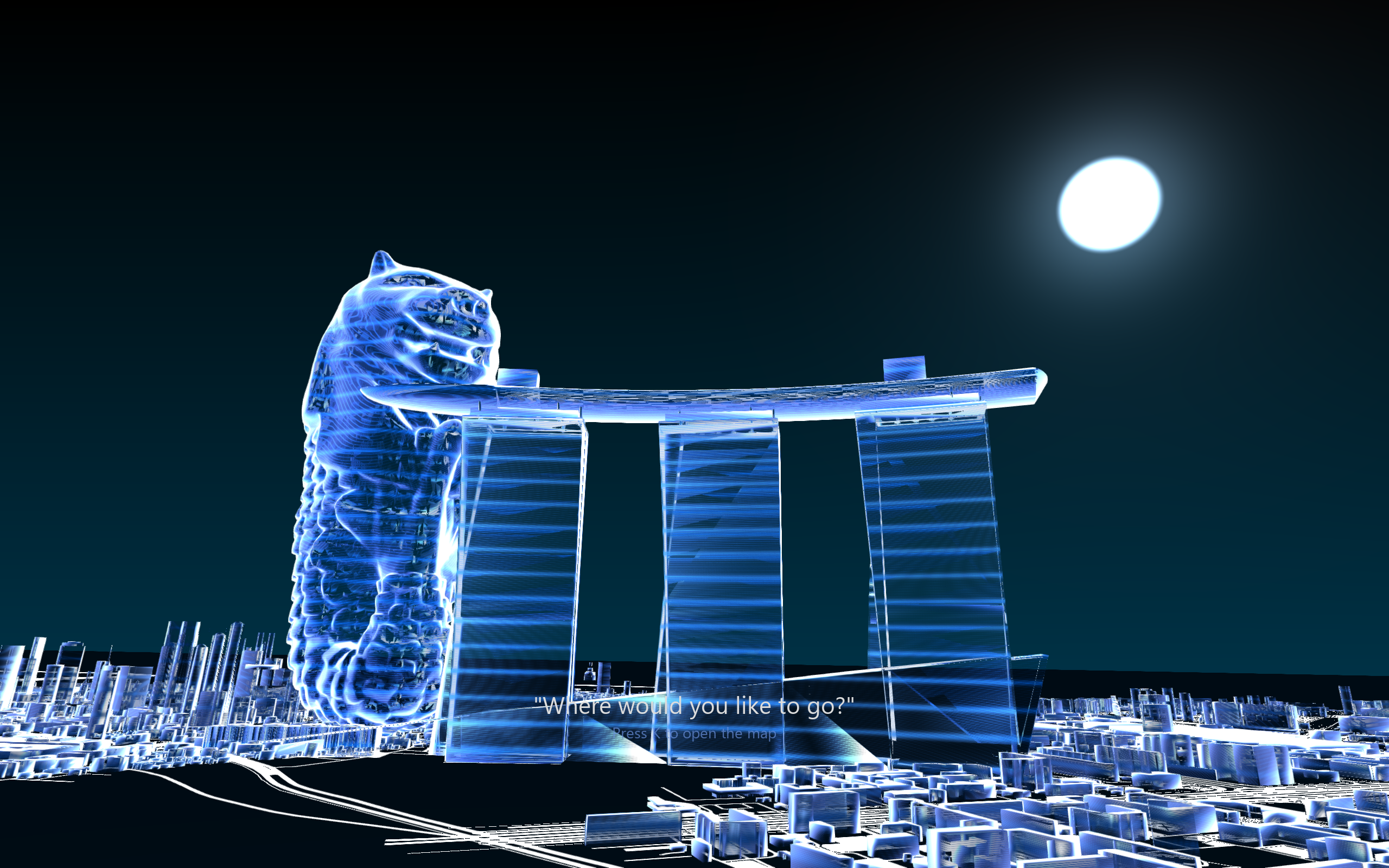
What the visitor watches while the cab moves. Individually modelled buildings, the bridge, the bay.
Texture · the hologram language
The projection-surface treatment that carries from cab to city. A live synthesis sits alongside three frames of the treatment in use.
The taxi interior itself stays minimal. No driver figure, no dashboard detail. The visitor’s body is implied by the framing rather than drawn. Everything the visitor looks at is outside the window, which is where the work is. The cab frame exists to create the inside-outside boundary and nothing else.
FINAL RESULT · END-OF-WEEK STATE