WEEK 10 · 2026-03-16 ~ 22
Bugis Interior Design & Audio
Recorded thirteen field sounds across Bugis, consulted a professional field recording artist, and started designing the Bugis interior around religious coexistence. The project's first district began taking its real shape this week.
Last week closed with the taxi exterior in place. The visitor now had an arrival moment that made sense. This week the work moved inside the cab. What plays inside the interior has to be the sound of the district itself, not a stand-in. Which meant it was time to stop using placeholder audio and go to Bugis with a recorder.
Two things happened across the week. I walked Bugis with a Zoom H1n and came back with thirteen recordings. And I began designing the Bugis interior around what the neighbourhood’s sound had been telling me about the place. The two tracks informed each other constantly. Recording something specific would change what the interior wanted to look like. Sketching a new detail of the interior would send me back to listen to a specific recording more closely.
RECORDING BUGIS
I went out across several days with the recorder, a set of good headphones, and a list of places I wanted to capture. Some of the recordings were planned. Others happened because I heard something interesting while walking and stopped. The final set was thirteen recordings spanning three kinds of space.
A wider pass of the locations I walked across the week. Religious interiors, commercial arcades, the lanes between them.
The thing that surprised me most was not any single recording. It was the comparison. All thirteen were captured within about one square kilometre of each other. Some locations are adjacent. But the recordings sound like they belong to different cities. The Background section of the dissertation had argued that sound changes faster than streets do, and I had believed that argument on paper. Carrying the recorder from one place to the next made it something I had heard with my own ears.
LISTEN TO BUGIS
The thirteen recordings are embedded below. Each one plays independently. Grouping is by kind of space rather than by recording order, because the differences between categories are more useful to hear than the chronology of how they were captured.
Kwan Im Thong Hood Cho Temple
관음당 사원
Bells and chanting carrying out into the surrounding streets during afternoon.
THE EXPERT CONSULTATION
After the recording sessions I reached out to Marina Jung Morgan, a field recording artist, to ask how to make these recordings communicate the character of a place more distinctly. My concern was that even careful recordings of Bugis sounded, in moments, like recordings of any dense Asian urban district. The crosswalk beeps are specific to Singapore, but the foot traffic and the air conditioning hum and the scattered conversation could be anywhere.
Marina’s answer reframed the question.
Her argument was that the ambient bed of a location, the continuous low-level sound that stays present throughout a recording, is the part that cannot be mistaken for somewhere else. The surface events within a recording (a specific conversation, a passing car, a moment of music) exist almost everywhere. Ambient does not. The ambient of a Buddhist temple interior is unique to that temple. The ambient of Bugis Street at 5pm is unique to Bugis Street at 5pm. The symbolic details that make a place readable should be layered on top of the ambient, not used instead of it.
Listening back to the thirteen recordings with this framing in mind, the ones that feel most like Bugis are not the ones where something dramatic happens. They are the ones where the underlying ambient holds the longest. This reshaped how I planned the sound for the interior. The audio playing inside the cab is built on layered ambient beds from multiple Bugis locations, with small symbolic details (a bell, a crosswalk beep, a fragment of market chatter) surfacing briefly on top.
THE IDEA OF BUGIS
The recording trip also changed what I understood the interior to be about. I had gone out thinking I was recording sound. I came back thinking I was recording a quality of the neighbourhood that I had not previously named.
Within less than a square kilometre of each other, Bugis holds a Buddhist temple, a Hindu temple, a mosque, and Christian churches. Four traditions with very different teachings and aesthetics, coexisting not only peacefully but almost transparently. The call to prayer from Sultan Mosque does not interrupt the chanting at Kwan Im Temple. The street market at Bugis Junction does not stop for either. The lanes between them run through all of it without taking sides. This is, for me, the actual subject of Bugis. Not any one culture. The fact that they share the same square kilometre and leave each other alone.
THE INTERIOR TAKES SHAPE
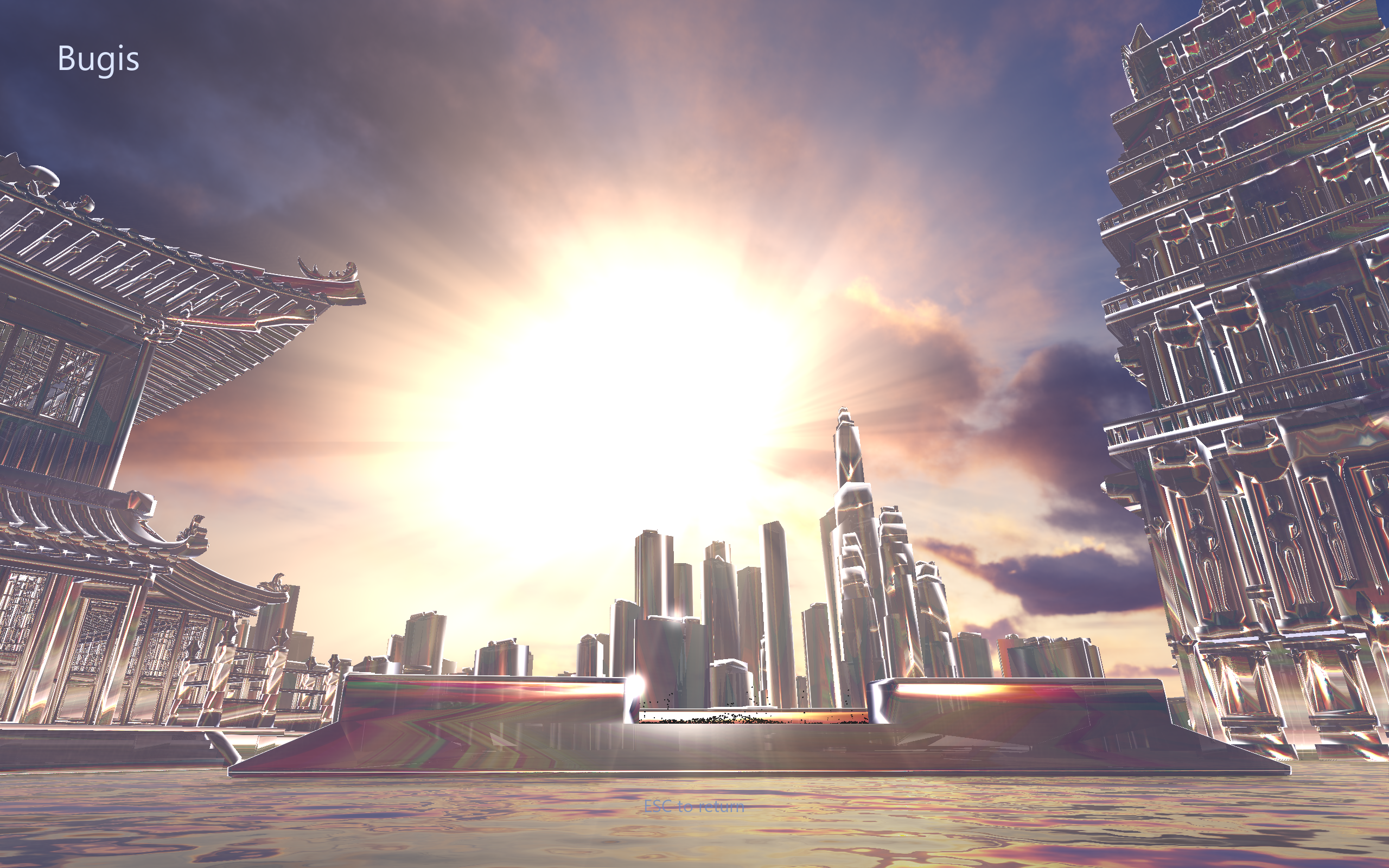
Before the reasoning, the space itself in motion. The ambient of the district playing underneath, the glass layering visible from the inside, the hologram language carried over from last week.
Mood footage of the Bugis interior. Glass layering, religious motifs held as transparent strata, ambient reading continuous with the taxi exterior.
The interior visual language that emerged from this concept is built on glass. Glass holds transparency, allows layering, and reads as sacred or ceremonial without being committed to any single tradition. A glass interior is a space where things sit side by side and are seen through each other. That is the grammar I wanted for this district.
The Buddhist element sits at the base of the visual composition because Buddhism has the strongest visible presence in Bugis. The other three traditions are modelled as abstract forms and layered into the space around the Buddhist base. None of them is literal. All four are treated as shapes and motifs rather than as religious iconography, which lets them coexist in the same composition without any of them feeling like appropriation.
The finished interior holds all four as transparent layers inside a glass architecture. The hologram language carried over from the taxi exterior and the MRT station work still applies. What sits beyond the window of the taxi is the Bugis exterior. What the visitor now enters when they commit to the Bugis district is this interior.
The finished Bugis interior. Glass textures hold the four religious motifs as transparent layers.
The detail views show how the glass texture carries the layering and how the particles from the PIC/FLIP system interact with the interior surfaces. The ambient sound layer from Bugis plays throughout this space, with the symbolic details Marina named surfacing occasionally through the mix.
One last close-up of the glass surface itself, isolated from the composition around it.
The glass texture in isolation. This is the surface that holds everything else.
FINAL RESULT · END-OF-WEEK STATE