WEEK 14 · 2026-04-13 ~ 19
East Coast Park
The ECP environment built last week was not yet alive. This week the sun started breathing, the god rays ran through the humid air, the park's own recordings replaced the Bugis placeholders, and the particles were rewritten to glow the way living things glow.
Last week the environment for ECP was built. Procedural sky, pond, terrain, eight tree models, grass that follows the ground. Everything a forest needs to be a forest. Everything except what would make it feel like one. Walking into the ECP scene at the end of Week 13 was like walking into a set before the crew had turned the lights on. The geometry was correct and the atmosphere was missing.
This week was the week the lights came on. Not the word lights in a generic sense. Real lighting decisions that carry the mood of the park, real particle behaviour that reads as living rather than mechanical, real audio recorded at the actual park, real sound feedback when the visitor touches the fluid. By the end of the week ECP existed as a place rather than as a scene.
BREATHING LIGHT
The sun was the first addition. A yellow sun in the procedural sky would have made the scene read as a regular outdoor render. The choice to make the sun green was not about realism. It was about signalling the same thing the glass in Bugis signals. This is not a documentary. This is a rendering of a place that has been translated into something else.
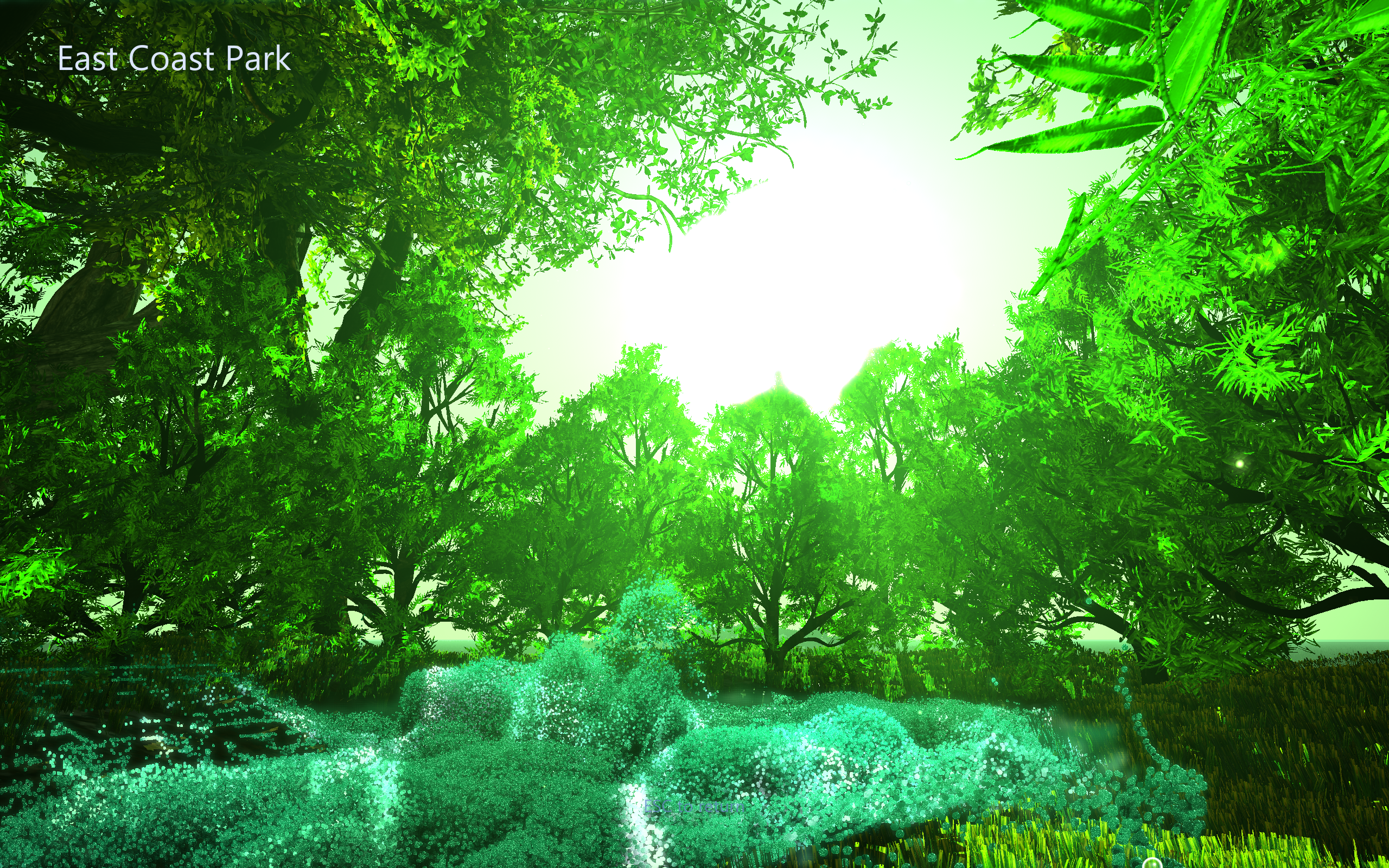
Five layers compose the sun. A bright core at the centre, an inner glow, a mid halo, an outer halo, and a shimmering rim at the edge. Each layer has its own radius, opacity, and colour falloff. The brightness of every layer is tied to the bass and energy bands of whatever audio is playing. When the park is quiet, the sun sits softly in the sky. When a wave crashes in the recording or a bird call spikes the high end, the sun pulses outward for a fraction of a second. The layering means that the pulse does not feel like a uniform brightening. The core flashes first, the halos swell more slowly, the rim shimmers more chaotically. The eye reads it as breathing rather than as blinking.
The Mystical Green Sun sitting high above the ECP canopy. Five layers compose it, and each layer is tied to the bass and energy bands of the playing audio.
Volumetric god rays were turned on the moment the sun was in place. The god ray pass runs at 128 ray-marching steps at full resolution, building actual light shafts that extend from the sun direction through the scene. Henyey-Greenstein phase scattering weights the forward scattering stronger than the back scattering, so the rays pointing toward the camera appear brighter than the rays pointing away. The effect this produces is that the air between the camera and the sun feels dense. Not empty. You can almost feel the humidity of the coast in the way the light moves through the space. This single addition carried more of the park’s mood than any other visual decision of the week.
128-step ray marching produces actual light shafts through the canopy. Henyey-Greenstein scattering makes the forward-facing beams brighter, so the air between viewer and sun reads dense.
A second lighting pass was needed for the trees. The standard directional lighting from the sun was creating silhouettes that read as flat black against the glow behind them. The trees from last week were supposed to feel like they were holding the last of the day’s light on their leaves, not like they were cutouts. A second light source was added, positioned at the Green Sun’s location, contributing through a wrap gradient and a translucency term. Wrap lighting brightens the surfaces facing slightly away from the light source, which softens the transition from lit to shadowed. Translucency sends a small amount of the light through the leaves, simulating how thin biological surfaces glow from behind when the sun is low. The trees stopped being silhouettes and started being part of the atmosphere.
A bloom bug had to be solved at this point. The standard bloom pass in the pipeline was depth-unaware, which meant the bright halo around the sun was bleeding over the top of nearby tree leaves and erasing their silhouettes. A depth-split bloom approach was implemented. The sky and the scene are composited through separate bloom passes. The sky bloom is masked by scene depth so it does not spill over objects in front of it. This allowed the sun to glow the way it should while the trees retained their outline against it. A small technical change with a large visible consequence.
THE PARK’S OWN SOUND
The audio track list was the next piece of the week. ECP had been running on the thirteen Bugis field recordings as placeholders since the multi-region system came online in Week 12. This was always meant to be temporary. The Bugis recordings drive Bugis particles beautifully but they drive the ECP scene with the wrong character entirely. Temple bells and crosswalk beeps in a forest at dusk feel like leakage from another world.
Marina’s principle from Week 10 held more strongly here than it had for Bugis. Bugis carries its symbolic detail density on top of an urban ambient bed. ECP has almost no symbolic detail. What ECP has is one continuous thing, the sound of the waves, and everything else (a bird call, a ship horn, a plane on approach to Changi) is a brief puncturing of that continuous thing. If the project was going to work in ECP, the audio had to reflect that.
The thirteen Bugis tracks were swapped out for actual recordings from the park. East Coast Park Ambient, Heavy Sea Wave, Wind Storm Ambient at the base. Tropical Birds, Bird Call, Koel Bird Call, Seagulls Sounds, Otter Sounds carrying the park’s own voice. Water Splash, People Running in Park, Airplane Cross the Sky, Ship Horn, Ship Engine as the passing intrusions. Grouping by the kind of thing the sound is, rather than by where it was captured, makes the shape of the park legible in a way the original Bugis five-category structure would not.
East Coast Park Ambient
이스트 코스트 파크 앰비언트
The continuous low-frequency bed of the park. Wind, distant water, the hum of presence that never quite leaves.
One change to the mixing logic mattered most. In Bugis every track’s volume fades with distance from its zone. Walking away from Kwan Im Temple means the temple sound fades. This is the correct behaviour for Bugis because the sounds are attached to specific locations in the neighbourhood. It is not the correct behaviour for ECP. At the actual park the sea is audible from every point on the park’s grounds. The waves do not fade just because you walk ten metres inland. The Sea Waves track was flagged as always-audible, meaning the mixer enforces a minimum volume floor for that specific track regardless of camera distance. The ambient of ECP is continuous the way the ambient of the real park is continuous, and the scene finally started to feel correctly like the place it was based on.
A crystal touch SFX system was added alongside the audio swap. When the visitor’s mouse crosses the particle field, a soft crystalline sound plays with stereo pan based on the mouse’s screen-space X position. A short cooldown prevents rapid retriggers from stacking into noise. Pitch varies by fifteen percent per sample to keep the sound interesting across long interactions. The effect is that moving the mouse through the particles feels like brushing a wind chime made of water. The same mouse, the same force code, and the same PIC/FLIP fluid that also run in Bugis, but the sound cue completely changes how touching the particles feels.
LIGHT THAT LIVES
The particle shader was the last piece, and the one that most distinguishes ECP from Bugis visually. Bugis particles behave like refracted crystal. Light passes through them and splits into colour. ECP particles had to behave like living things that emit their own light.
The shader is called bioluminescent and its structure is deliberate. A PBR GGX specular lobe handles the base light physics. A Fresnel rim term brightens the edges of each particle so they glow at their silhouette rather than only at their centre. A three-dimensional FBM noise field modulates the glow intensity organically, giving each particle a subtle breathing quality as it moves through the noise field rather than a flat uniform brightness. And a per-zone glow term ties the glow of each particle to which of the thirteen audio zones it is currently inside, so particles in the Sea Waves zone glow differently from particles in the Koel Bird zone or the Airplane Landing zone.
PIC/FLIP particles running under the bioluminescent shader. Each particle carries its own glow, and per-zone modulation is visible in the variation of brightness across the field.
The references for this look were not digital. They were biological. Fireflies in a clearing. Deep-sea creatures that carry their own light. Moss and fungi that glow at night under low humidity. The tonal range kept to the cool end (greens, teals, and whites near the edges) because warm glow would have been too close to the Bugis palette and would have muddied the distinction between districts. What separates the two districts visually, more than any single design choice, is that Bugis is light passing through material and ECP is material producing its own light.
The pond at dusk once every pass is live. Particles carrying their own light, god rays filtering through the canopy, the ambient of the park holding the scene together.
FINAL RESULT · END-OF-WEEK STATE